Quick facts
- Scientific name
- Poecile atricapillus
- Conservation status
- Least concern
- Habitat
- In woods and thickets, both deciduous and evergreen, but avoids coniferous trees; most common along the forest edge
Appearance
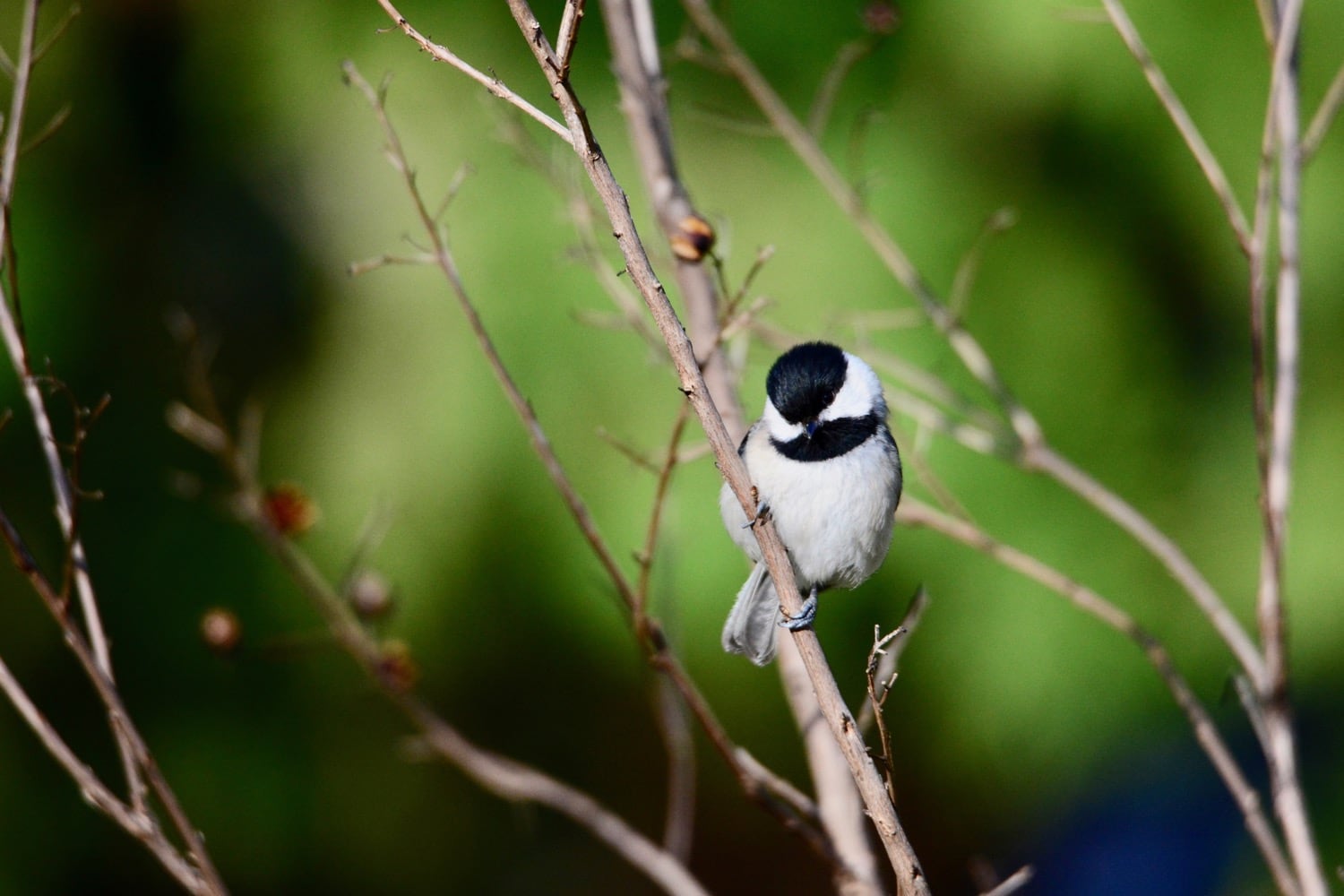
Black-capped chickadees are small birds with distinctive black stripes on the top and bottom of its head. It has gray wings and back, and a white underside.
Behavior and diet
These birds are unafraid of humans, with a habit of investigating everything in their territory. They are easily attracted by birdfeeders in your yard – both ones that hang from a branch or pole, and ones attached to your house in front of a window.
Black-capped chickadees mostly eat berries, seeds, and insects, but their preferred food varies with the season. They will also eat suet if provided in your birdfeeder.
Habitat and distribution
Black-capped chickadees are widespread across North America. They are commonly found in the upper half of the United States and the lower half of Canada during all seasons, and occasionally found further south during the winter.
Chickadees live in evergreen and deciduous woods, usually in thickets, groves, and shade trees. They are most common near the forest edge; they mostly avoid coniferous forest. As they tolerate humans, chickadees will live in the suburbs, near houses and development.
Further reading
This page contains information from Audubon Field Guide and the Cornell Lab of Ornithology. You can find more information about black-capped chickadees on their websites: